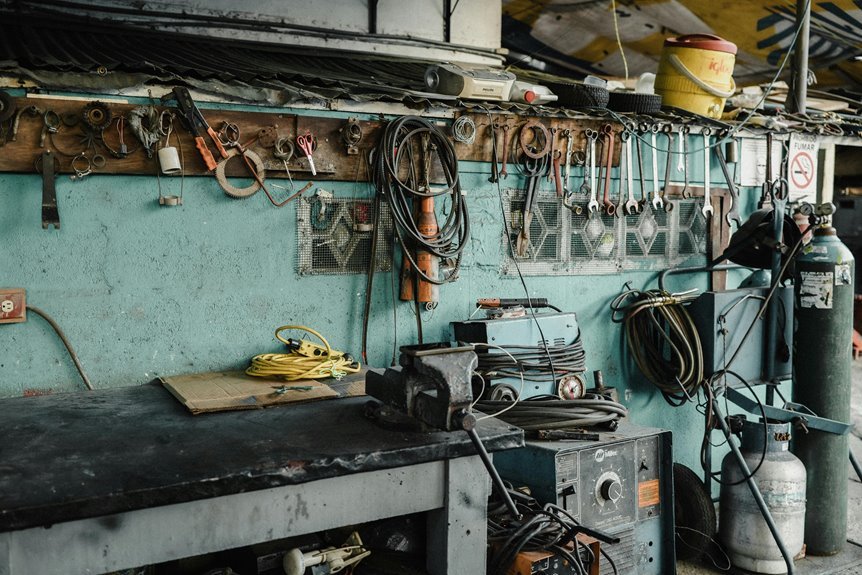

Upon setting up a workbench, you want it to feel solid under your hands, not like it’s contemplating giving up. The best benches pair weight, level support, and smart features so planing, clamping, and assembly feel easier, not harder. Strong legs, a thick top, and tight joinery all help stop wobble, while vises, dog holes, and nearby storage keep your tools within reach. Once you see how each part affects the whole, the choices get a lot clearer.
What Makes a Workbench Stable?
A workbench stays stable while its frame, top, and weight all work together, and that’s what separates a bench that feels solid from one that shifts under your hands. You want bench mass, because heavy parts help the bench resist pushback when you plane or clamp. You also want a level base, so shop floor leveling matters before you blame the bench itself.
Next, check the legs and joinery, since they should fight side-to-side sway and front-to-back rocking. Then look at the top, which should spread force instead of twisting. In case you’re setting up a shared shop, that steady feel helps you settle in fast. You’ll work easier as soon as the bench doesn’t argue with you.
Workbench Materials That Resist Wobble
When you want a bench that stays put, solid hardwood gives you the dense, steady frame that fights side-to-side shake.
You can also add steel reinforcement to lock weak spots down and keep the bench from twisting under load.
Together, these materials help your workbench feel firm, calm, and ready for real work.
Solid Hardwood Frames
- Dense stock helps legs stay square.
- Straight grain handles stress better.
- Tight joints spread force across the frame.
- Wide parts calm small floor flaws.
- Proper drying lowers seasonal twist.
Once you build this way, you join a crew that values solid footing.
Your bench won’t feel fussy or shaky, and that matters whenever you want your tools, and your patience, to stay put.
Steel Reinforcement Options
When your bench still wobbles after you’ve built the wood frame well, steel can bring the calm it needs.
You can add flat bar under the top, angle iron at the legs, or a rear cross brace to stiffen the whole setup.
Smart steel gusset placement helps you stop twist where force hits hardest, so the bench feels planted while you plane or clamp.
When you want a stronger fix, welded reinforcement methods let you lock those joints together for a cleaner, tighter frame.
You don’t need a huge steel build to feel safe and steady.
Even a few well-set pieces can make your bench feel like it belongs in your shop, ready for real work, not constant fussing.
How Legs and Frames Support a Workbench
Your workbench stays steady while its legs carry the load straight down to the floor, not out to the sides. Frames and braces then spread that force, so the bench resists wobble while you push, clamp, or plane. Strong joinery, like tenons, dovetails, and bolts, locks those parts together and keeps the whole structure feeling solid.
Leg Load Paths
Whenever you look at a workbench that feels solid, you’re really feeling the path the load takes from the top down into the legs and then into the floor. With load path analysis, you can see how each board, screw, and joint shares the weight. Good leg force transfer keeps the bench calm as you plane, clamp, or hammer.
- Wide leg stance spreads stress.
- Tight joints keep movement small.
- Thick tops send force downward cleanly.
- Straight grain helps legs carry load.
- Even feet help the bench sit true.
Whenever you trust that flow, you work with less doubt. Your bench stops acting like a trick chair and starts feeling like a teammate at your side.
Frame Bracing Roles
A strong workbench doesn’t stay steady due to chance, because its frame keeps pushing the load where it belongs. You feel that support as the legs work with rails and stretchers, not against them. Good frame bracing also helps cabinet carcass bracing as spreading stress and keeping the base square.
| Part | What it does | Why you care |
|---|---|---|
| Front rail | Ties the legs together | Cuts sway |
| Side brace | Links the long span | Helps with racking |
| Lower panel | Adds mass and support | Feels solid under tool push |
As you build in seasonal movement control, you let the top shift a little without shaking the whole bench. That small freedom keeps your workspace friendly, steady, and ready for real use, so you can work with confidence every day.
Joinery For Rigidity
Strong joinery does more than hold wood together, because it turns a pile of parts into a bench you can trust.
Whenever you build for rigidity, you give your legs and frames a shared job, so they fight wobble as one.
That matters whenever you lean hard, plane fast, or clamp with grit.
- Use mortise tenon joints for leg-to-apron strength.
- Add dovetail joinery where frames must resist pull.
- Tighten through-bolts on lighter builds.
- Keep shoulders square so force moves cleanly.
- Pair strong joints with stout braces and thick stock.
You’ll feel the difference whenever the bench stays calm under pressure.
Then your work feels calmer too.
Solid joinery helps you belong in the shop, because the bench holds steady like a good teammate.
Choosing the Right Workbench Size
Just as the right bench height helps you work with less strain, the right bench size makes every task feel easier and safer. You want enough bench footprint for your tools, yet not so much that your shop feels crowded. Measure the space where you’ll stand, then leave room to move boards, turn around, and share the area without bumping elbows.
A bench that matches your ergonomic reach lets you clamp, plane, and assemble without stretching too far, which keeps your work smoother and your body calmer. Should you build for one main task, size the top to that job. In the event you do mixed work, choose a middle ground so you can grow into it. That way, your bench feels like it belongs with you.
Useful Workbench Features for Daily Tasks
When your bench supports real daily work, the best features are the ones that save time, reduce frustration, and keep your pieces steady. You want daily workflow convenience that feels natural, so your hands can stay on the job instead of hunting for tools. Quick access surface features matter because they let you set down screws, square, and pencils without breaking rhythm.
- Open storage keeps your go-to tools close.
- A front vise helps you lock parts fast.
- Dog holes give you flexible clamping spots.
- A lower shelf holds heavy gear within reach.
- Rounded edges make long sessions kinder on your arms.
As you build around these details, your bench feels like part of your crew, not just a slab of wood.
Picking the Best Workbench Top
A great workbench feels steady from the start, but the top is where that feeling really lives, so picking the right one matters more than most people suppose. You want a top that fits how you work and how long you plan to stay in the shop.
Choose solid wood when you value easy repair and a warm feel. Pick plywood or laminate when you want a flatter surface with less fuss. Check bench top thickness, because a thin top can flex when you lean hard or clamp fast. Also consider seasonal wood movement, since wood grows and shrinks with the weather. Should you leave room for that change, your bench stays true. Whenever the top feels right, you do too.
Workbench Storage That Keeps Tools Close
Tucked under the bench, smart storage can save you more time than a fancy tool ever will.
- Put daily tools in shallow drawers.
- Use labels for quick grabs.
- Keep tool storage near your dominant hand.
- Add drawer organization for bits, pencils, and gauges.
- Leave one open shelf for bulky items.
When you can reach what you need without hunting, your shop feels calmer and more welcoming. You stay in the flow, and your bench starts to feel like part of your team.
A side cabinet or rolling tray can hold clamps, blocks, and layout gear while keeping the top clear.
Small bins help you sort fasteners, while dividers stop clutter from mixing.
That way, every item has a home, and you do too.
Vises, Clamps, and Hold-Downs for Better Control
When you want your workbench to feel steady in your hands, the vise and hold-down system matter just as much as the top itself. You’ll work with more confidence as vise alignment keeps the jaw square and true. Then each turn grips the stock instead of twisting it away from you.
Use a front vise for edge work, and add bench dogs or a T-track clamp whenever you need firmer control. Good clamp pressure should feel snug, not crushing, so your piece stays put without damage. Hold-downs help even more on planing tasks, because they press down while your hands guide the tool.
Whenever these parts work together, you get less slip, less strain, and a bench that feels like it’s backing you up.
Matching Your Workbench to the Job
Now that your vise and hold-downs can keep stock from creeping, the next question is whether the whole bench fits the kind of work you actually do. You want a bench that feels like part of your crew, not a hurdle.
- Whenever you move often, choose jobsite portability.
- Whenever you build cabinets, favor a flat, stiff top.
- Whenever you carve or plane, look for specialty task fit.
- Whenever you work alone, pick a bench with easy reach.
- Whenever you store tools below, add mass and rigidity.
A light bench can travel, but it might dance during hard cuts. A heavy bench stays calm and steady. Match height, storage, and surface space to your hands, your tools, and your pace. That way, your bench supports you instead of slowing you down.
Frequently Asked Questions
How Much Weight Can a Height-Adjustable Workbench Safely Support?
It depends on the model, but many height adjustable workbenches can support several hundred pounds if you stay within the rated load limit and follow the manufacturer’s safety guidelines. Add weight gradually and keep the load evenly distributed for better stability.
Does Bench Stability Change Between Low and High Working Positions?
Yes, the bench usually feels steadier when it is set low because the center of gravity is lower. At higher settings, the bench can move more, so stance, bracing, and how the load is placed become more important.
How Do Imperfect Studs Affect Leg Alignment During Assembly?
Imperfect studs can throw off leg alignment during assembly, but overlapping braces will still draw the legs into stud alignment and square the frame, giving the bench a firm, custom feel.
Can a Bench Top Expand and Contract Without Cracking?
Yes. A bench top can expand and contract without cracking if you allow seasonal wood movement, fasten it loosely, and use aprons, slotted fasteners, or nails that hold the top while still letting it flex.
What Hold-Down Method Works Best for Narrow Workpieces?
For narrow workpieces, a planing stop or T track clamps usually gives the most reliable hold down, because both keep the piece secure without much expense.